

The Hidden Cost of Running Your Dealership on Multiple Systems

April 3, 2026
10 min read
As an independent dealer, you’ve probably said this at some point -
“My tools work fine.”
“I already have enough systems.”
“I already have a DMS.”
And on the surface, that’s true. Cars are getting bought. Deals are getting closed. Money is coming in.
It’s only when inbound starts slowing down and conversations take longer to close that owners begin to question what’s actually happening inside their systems.
Many dealerships are not running into problems because their tools don’t work. They run into problems because those tools don’t work together. The cost of that doesn’t show up in one place.
You only see the true cost of disconnected tools once you experience a connected system. For example, one dealer who moved to dealr.cloud for accounting shared that what surprised them wasn’t the accounting itself, but how much smoother their CRM, inventory, and day-to-day operations became once everything was finally connected -

Let’s look at a few areas to evaluate if the hidden costs of disconnected tools are silently hurting your dealership.
1. What Does “Working Fine” Actually Mean in Dealership Systems?
“Working fine” usually means nothing is broken. You can:
- List inventory
- Manage leads
- Close deals
But it also means you’ve accepted a certain way of operating.
You check one system for inventory, another for leads, another for accounting. You rely on people to connect the dots between them. Over time, this becomes normal.
That’s where the gap is.
Surface-level operations continue smoothly, but underneath:
- Numbers don’t match across systems
- Teams rely on memory instead of data
- Financial clarity comes late
You don’t notice it day-to-day because things are moving. But decisions are being made without full context. And in a dealership, small misses compound quickly.
2. How Many Systems Are You Using Daily?
Think about a typical day. You log into:
- Inventory or DMS
- CRM for leads
- Accounting software
- Recon tracking tool
- Website or listing platform
Each of these tools serves a purpose. None of them are the problem on their own.
The issue is how often you switch between them.
A single deal might look like this:
A lead comes in through your CRM. You check inventory separately to confirm availability. You send details manually. When the deal progresses, you re-enter that customer into your DMS. Later, accounting updates happen in another system.
This is not one workflow. It’s a chain of disconnected steps.
Each step introduces:
- Time delay
- Risk of error
- Dependency on the person doing it right
Over a week, this turns into hours spent moving information instead of acting on it.
3. Where Dealership Data Starts Breaking Down
One of the biggest hidden issues in multi-system setups is data inconsistency.
The same vehicle can show different numbers depending on where you look. Inventory might show one cost. Accounting might reflect another. Sales might be working off something else entirely.
Why does this happen?
Because each system maintains its own version of the data.
There is no single place where:
- Purchase price
- Recon cost
- Total investment
are tied together in real time.
This creates a situation where teams are not aligned on the same numbers. When that happens, pricing decisions are based on partial information. And partial information always carries risk.
4. Why Systems That Don’t Talk Create Blind Spots
Disconnected systems don’t just slow things down. They create blind spots in your operation.
Take service and accounting.
A car goes through recon. Work is done. Costs are incurred. But if that information doesn’t immediately reflect in accounting, the financial picture remains incomplete.
Now sales steps in.
They price the car based on what they see. If recon costs are missing or delayed, the margin looks higher than it actually is.
The deal gets closed. Only later does the real number show up.
That gap directly affects profitability.
The same happens between CRM and inventory.
A lead comes in. The salesperson needs to check vehicle details. If systems are not connected, they pull information manually. That adds delay. In many cases, it also reduces response speed.
And in a competitive market, response speed matters.
5. What Manual Data Entry Is Costing You Every Week
Manual work is easy to ignore because it feels routine.
Entering the same customer twice. Moving deal details from one system to another. Updating costs manually.

Each task takes a few minutes. But across the team and across the week, it adds up.
More importantly, manual entry introduces inconsistency.
- A number is entered slightly differently
- A field is skipped
- A follow-up is missed
These are small issues individually. But they create friction across the entire operation.
It also affects how your team works.
Instead of focusing on customers and deals, they spend time managing data between systems.
6. Do Integrations Actually Solve the Problem?
Many dealerships try to solve this by connecting their systems.
They use integrations or APIs to sync data across tools.
This helps, but only to a point.
Most integrations:
- Sync at intervals, not instantly
- Transfer limited data, not full workflows
- Still rely on multiple systems to function
So even though systems are technically connected, operations remain fragmented.
You might have:
- Recon updates syncing later
- CRM not reflecting real-time inventory changes
- Accounting catching up after the fact
This creates a lag between action and visibility.
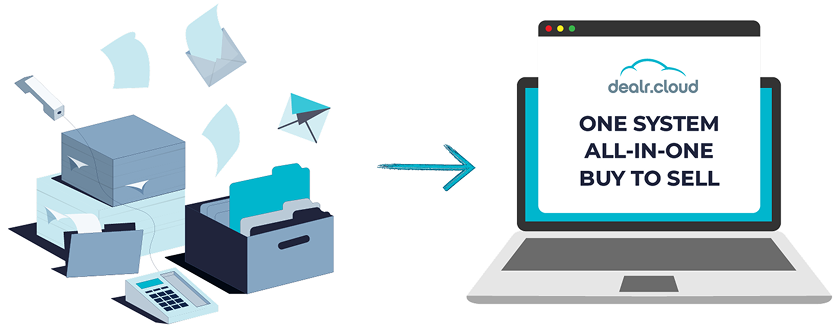
True integration means everything works in one system - without re-entering the same details again and again.
7. Why Dealership Dashboards Don’t Show the Full Picture
Dashboards are often seen as the solution. They pull data from different systems and present it in one place. But dashboards are only as good as the data feeding them.

If underlying systems are delayed or inconsistent, dashboards reflect that.
Most dashboards show:
- Sales performance
- Inventory metrics
- Revenue summaries
But they do not give real-time operational clarity.
You are often looking at:
- Yesterday’s numbers
- Last week’s activity
- Month-end summaries
That works for reporting. It does not work for day-to-day decisions.
Dealerships operate in real time. Pricing, buying, and selling decisions cannot wait for delayed visibility.
8. What Real-Time Data Should Actually Look Like
Real-time data is not about more information. It’s about having the right information in one place.
For a dealership, this comes down to a few things.
You should be able to see the full financial picture of a vehicle without switching systems.
That includes:
- What you paid for it
- What you spent on recon
- What it is currently worth
- What margin you are working with
You should also know where each car stands operationally.
Is it still in recon? Waiting for parts? Ready for listing?
And on the sales side, you should know:
- Where leads are coming from
- Which sources convert
- What each lead actually costs you
When these pieces are connected, decisions become clearer.
Pricing becomes more accurate. Inventory moves faster. Marketing spend becomes more intentional.
9. When Should You Consider Switching Your DMS?
Switching DMS is not an easy decision. Many dealers avoid it until something forces the change. That point usually comes when operations start stretching the current setup.
You may notice:
- Growth across multiple locations creating complexity
- Rising costs without clear visibility
- Delays in understanding true profitability
- Teams spending more time managing systems than selling cars
At that stage, the question is no longer about whether your tools work. It becomes about whether your current setup can support the way you operate today. Familiarity often keeps things in place longer than it should.


With dealr.cloud, you’re not just adopting software, you’re embracing the future of your dealership. The tools are here, the technology is here, and the dealers who move forward will thrive. If you want to build something lasting, to make money, support your family, and create a true second-generation dealership, then you need the right foundation. dealr.cloud gives you exactly that.
10. What a Connected Dealership System Changes Day-to-Day
When systems are connected at the workflow level, daily operations feel different.
You are not switching between tools. You are moving through one process.
From acquisition to sale, everything flows in sequence.
A vehicle comes in. It gets evaluated, reconditioned, listed, sold, and accounted for within one environment.
That changes how teams work.
Sales sees accurate numbers. Service updates are reflected immediately. Accounting is no longer delayed.
There is less back-and-forth. Less duplication. Less guesswork.
You spend less time managing systems and more time running the dealership.
That is where operational control comes from.
Summary: How Running Your Dealership on Multiple Systems Costs You
Final Thoughts
Most dealerships don’t notice the cost of multiple systems because it is spread out. A few minutes here. A missed cost there. A delayed update somewhere else.
But over time, it adds up.
Ask yourself: Where are hidden costs slipping through without you noticing - in recon, pricing, or missed follow-ups?
.png)

%20isn%E2%80%99t%20as%20Disruptive%20for%20You%20Think.png)